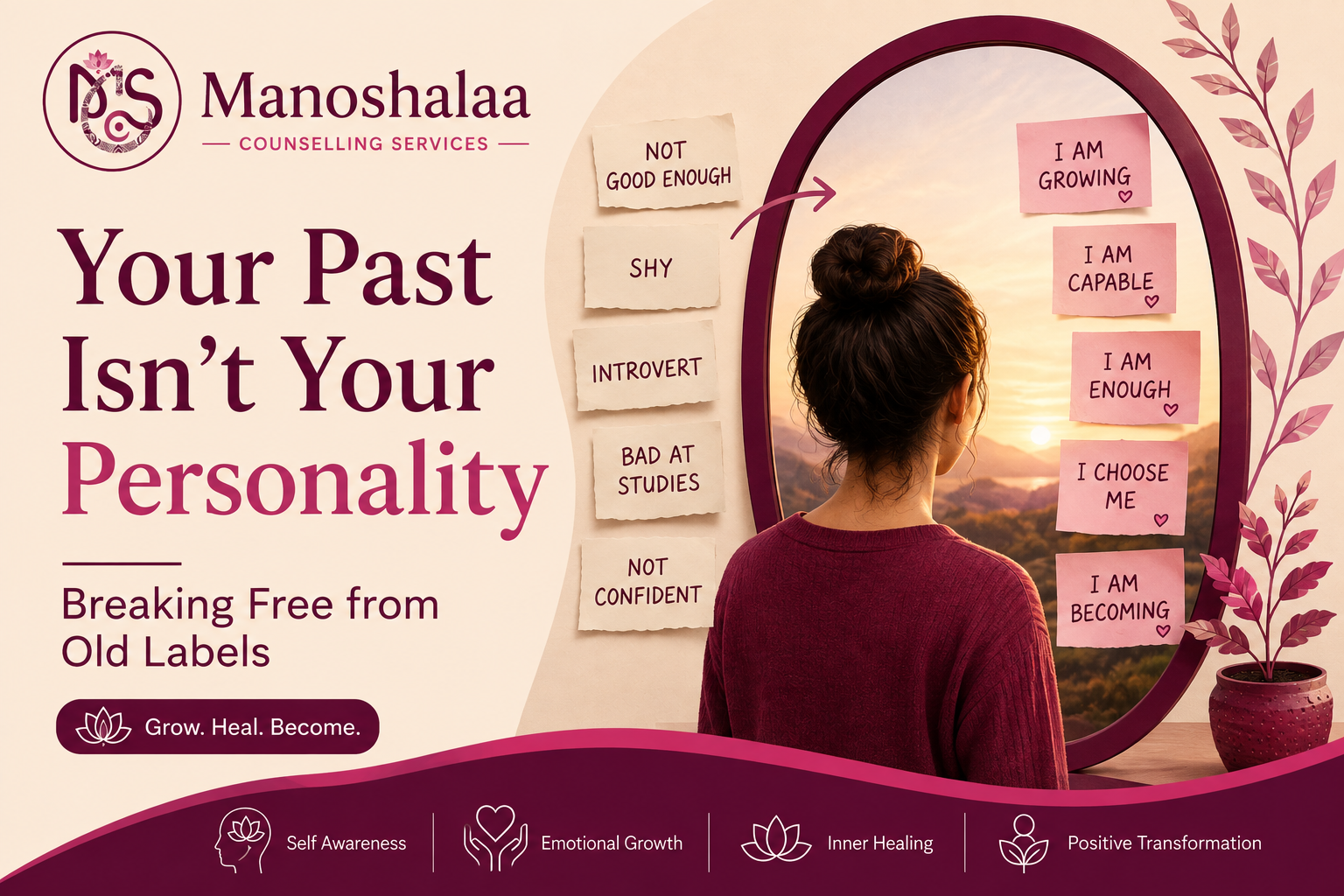
Your Past Isn't Your Personality: Breaking Free from Old Labels
Breaking Free from Old Labels
Aug 25, 2026
Manoshalaa
Whenever we get new clothes and adjust them in the wardrobe and if we find our closet to be full, we remove the old clothes and keep new clothes in replacement of old clothes—likewise we must break free from old labels and cherish new titles.
Have you ever caught yourself saying:
"I've always been like this." "I'm just not confident." "I'm bad at talking to people." "I've never been good at academics." "I'm an introvert, so I can't do that."
Sometimes, these statements sound like simple observations about ourselves, but they are deep titles that are buried deep into our conscience. These old labels that we have carried for so long, we mistake them for our personality.
Maybe someone called you "shy" when you were a child. Maybe a teacher once told you that you weren't good enough. Maybe you failed at something important and started believing that you were a failure. Maybe people around you constantly compared you with someone else.
Over time, these experiences can become part of the story you tell yourself, and we often take our decisions based on these inputs. Counselling psychologists in India can help you in understanding your true self and how not to make judgments based on our old self.
Your past explains some of your patterns. It does not permanently define who you are.
Your personality is not a museum of everything that has ever happened to you. As we say, change is the only constant—likewise we must allow ourselves to change and break free from past titles.
How Old Labels Become Part of Our Identity
Imagine a scenario where a student fails to answer a question and her teacher addresses her as "you are not good at studying." When the teacher gives this remark, the student learns that she is not good at studying and develops personality according to that, but it is a learned response and not her real response. We tend to build our personality based on learned responses rather than real and conventional experiences.
Whenever someone gives us a remark, we must not learn it; rather, we should sit with the remark, practice self reflection, and analyze the statement. After doing deep analysis, we should tell ourselves that even if I was wrong, I'll correct my mistake and take learning from that particular experience.
The Difference Between Your Past and Your Personality
Your personality refers to relatively stable patterns in how you think, feel, and behave.
Let's understand this aspect through an example.
There was a past experience of yours where you were repeatedly criticised for making mistakes. Now the person makes his own belief system where she thinks that "If I make mistakes, people will judge me." Because of this belief system, she avoids taking risks and has a low ambition drive. If we weave this, this incident particularly means that the original experience was about being criticised. But over time, she created an identity around it.
This is why understanding your old labels matters, because sometimes the person you think you are is actually the person you learned to become in response to your environment.
Why We Hold On to Old Labels
Counselling psychologists in India have done a study on human behaviour and their study reveals that human beings tend to keep familiar feelings with them as they feel safe. Even negative beliefs can become comfortable because we know what to expect from them.
If you believe you're "not smart enough," you may avoid challenging opportunities. If you believe you're "too sensitive," you may stop expressing your feelings.
The label gives you an explanation, and this becomes one of our biggest limitations.
The Hidden Cost of Saying "This Is Just Who I Am"
When you repeatedly tell yourself:
"I'm bad at relationships." "I'm terrible with money." "I'm not creative." "I'm socially awkward." "I'm too emotional." "I'm lazy." "I'm not a leader."
You may unconsciously start behaving in ways that confirm those beliefs. Due to lack of self confidence, self reflection, and self esteem, we never sit with our thoughts and contemplate on them. We simply carry forward our old beliefs and build our new beliefs based on old ones.
How to Break Free From Old Labels
Breaking free from an old identity doesn't happen by simply saying, "I'm a completely different person now."
It begins with becoming aware of the story you have been repeating.
These are the steps of "How to Break Free From Old Labels."
1. Identify the Label
The first and foremost thing we should do is to identify the label.
Ask yourself: "What is one thing I repeatedly say about myself?"
Maybe it's: "I'm not confident." "I'm bad at studying." "I'm difficult to understand." "I'm not a people's person."
To understand ourselves better, we must write down all the labels we have and without judging it, we should observe it. When we bring old labels to our consciousness, we become more aware of them.
2. Ask Where the Label Came From
Now ask: "When did I first start believing this about myself?"
Was there a particular experience? A teacher? A parent? A friendship? A breakup? A failure? A period of rejection?
Sometimes discovering the origin of a belief helps you realise that it isn't an objective truth.
It was a conclusion you made based on what you experienced at that time.
3. Separate Facts From Interpretations
This is one of the most powerful exercises.
Suppose your belief is: "I'm bad at communication."
Ask yourself: What are the facts?
Maybe you struggled during a presentation three years ago. That's a fact.
But: "Therefore, I am bad at communication." That's an interpretation.
One experience doesn't necessarily define a permanent ability.
Try separating: What happened from what I decided it meant about me.
4. Look for Evidence That Challenges the Label
Our minds naturally notice information that confirms what we already believe.
So deliberately look for evidence that doesn't fit your old identity.
If you believe you're not confident, ask: When have I spoken up despite being nervous? When have I handled a difficult situation? When have I tried something unfamiliar? When has someone appreciated my communication?
You don't need to prove that the opposite label is true.
You simply need to recognise that the old label isn't the complete story.
Replace Identity Statements With Growth Statements
One simple way to change your self-image is to change the language you use with yourself.
Instead of: "I'm bad at public speaking." Try: "Public speaking is something I'm still learning."
Instead of: "I'm not disciplined." Try: "I'm working on becoming more consistent."
Instead of: "I'm terrible at relationships." Try: "I'm learning how to build healthier relationships."
Notice the difference.
The first statements sound permanent. The second ones leave room for growth.
That small change in language can create a completely different relationship with yourself.
5. Stop Trying to Prove Your Old Self Right
Sometimes we unconsciously protect our old identity.
If you've always considered yourself "the quiet one," you may feel uncomfortable when you become more outspoken.
If you've always been "the unsuccessful one" in your family, success might strangely feel unfamiliar.
If you've always been "the responsible one," asking for help might make you uncomfortable.
Growth can feel strange because your new behaviour doesn't match your old identity.
That's okay.
6. Feeling unfamiliar doesn't mean you're being inauthentic.
Sometimes it simply means you're growing.
Breaking free from old labels isn't about creating a fake version of yourself. It's about questioning the identities you accepted without realising you had a choice. You can acknowledge your past without living inside it, learn from your mistakes without becoming your mistakes, remember who you were without being trapped by who you used to be. Most importantly, you can give yourself permission to change.
Because sometimes the biggest step in personal growth isn't becoming someone new.
It's finally realising that you were never limited to the version of yourself that your past created.
Counselling psychologists in India can help you immensely in understanding your old labels and also help in building a positive belief system.
By Manoshalaa
Contact Info
Chandigarh, India
9817303032
officialmanoshala@gmail.com
© 2026 Manoshalaa. All rights reserved.
Developed by TerraDigitalize Dynamics