
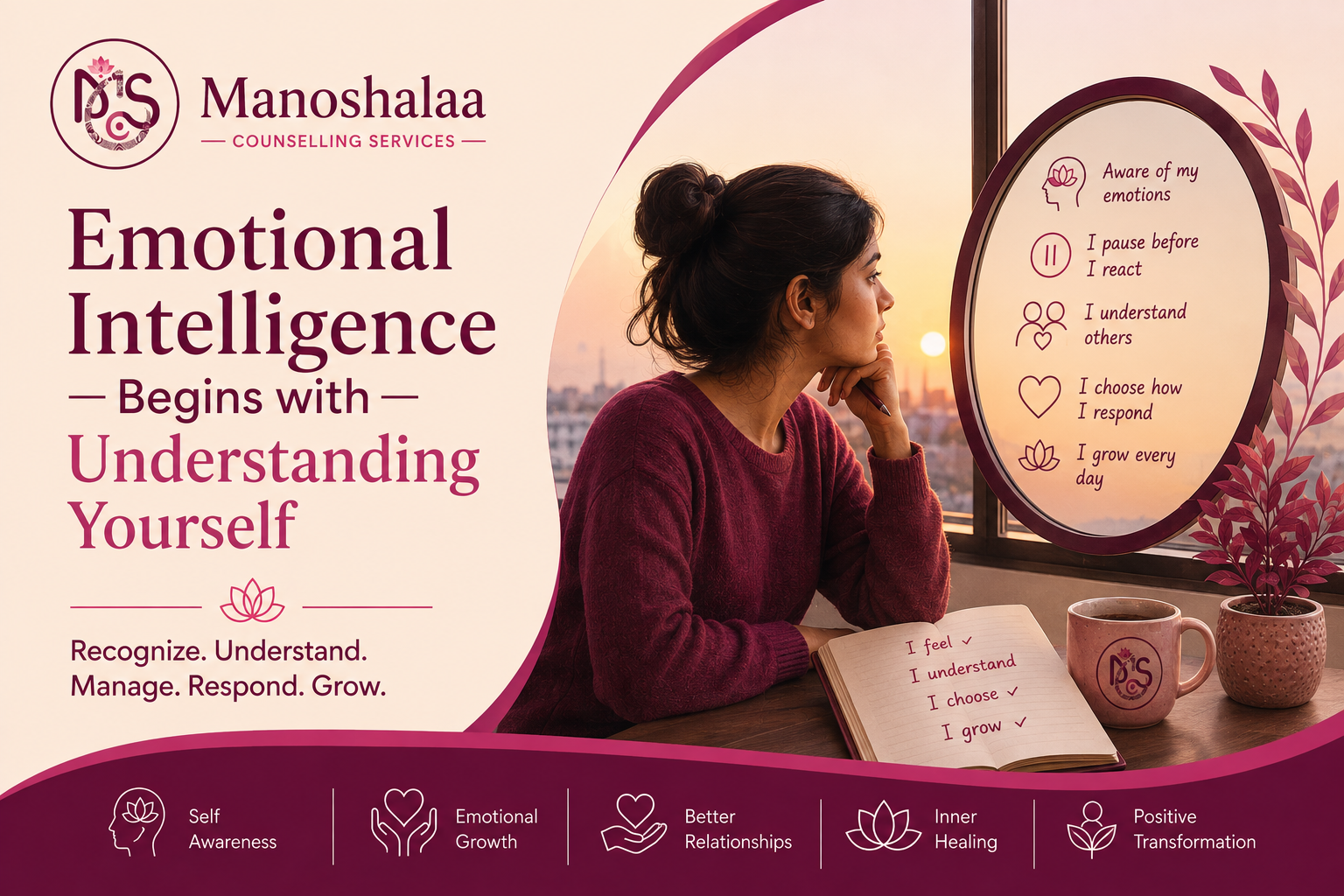
Emotional Intelligence Begins with Understanding Yourself
The Day She Started Understanding Herself
Aug 25, 2026
Manoshalaa
The Day She Started Understanding Herself
Ananya was always the kind of person who felt things deeply.
If someone spoke to her rudely, she would think about it for the rest of the day. If a friend ignored her message, she would immediately wonder, "Did I do something wrong?" If someone criticized her work, she would either become defensive or quietly lose confidence.
She often told herself, "I'm just an emotional person."
But slowly, she started realizing that being emotional wasn't the problem.
Not knowing what to do with those emotions was. Counselling psychologists in India recommend that having emotional intelligence is necessary to stay happy and have a satisfied life.
One evening, after an argument with her colleague, Ananya came home frustrated.
She threw her bag on the chair and sat on her bed.
"Why do people always misunderstand me?" she thought.
For the first time, instead of blaming the other person, she asked herself a different question:
"Why did their words affect me so much?"
She didn't have an answer.
And that question stayed with her.
The First Step: Understanding Herself
The next morning, Ananya started paying attention to herself.
Whenever she felt angry, she tried to identify what was happening inside her.
I'm angry.
Then she asked:
But why?
Sometimes the answer was embarrassment. Sometimes it was insecurity. Sometimes it was fear of being rejected.
And sometimes, she realized, she wasn't actually angry at all.
She was simply tired.
For the first time, Ananya understood something important:
An emotion is a signal, not a command.
Feeling angry didn't mean she had to shout. Feeling hurt didn't mean she had to send a long message. Feeling afraid didn't mean she had to give up.
She could feel an emotion without immediately acting on it.
The Second Step: Learning to Pause
A few weeks later, something similar happened at work.
Her manager criticized a presentation she had prepared.
Her first instinct was to defend herself.
She could already feel the anger rising.
But this time, she stopped.
She took a breath.
She asked herself:
"What am I feeling right now?"
Anger.
"What is underneath the anger?"
Fear.
She was afraid that the criticism meant she wasn't good enough.
That realization changed her response.
Instead of saying, "I worked really hard on this. You don't appreciate it," she calmly asked:
"Could you tell me what I could improve?"
Her manager explained the problems.
And surprisingly, Ananya didn't feel attacked anymore.
She realized that she had been reacting to what the criticism meant to her, rather than what was actually being said.
The Third Step: Understanding Other People
As Ananya became more aware of her own emotions, she started noticing something else.
Other people had emotions too.
Her friend who suddenly became quiet might not be angry with her. Her colleague who sounded irritated might simply be having a difficult day. Her mother who kept asking questions might not be trying to control her.
She started listening instead of immediately assuming.
One day, her friend cancelled their plans at the last minute.
Earlier, Ananya would have immediately thought:
"She doesn't value me."
This time, she asked:
"Is everything okay?"
Her friend paused and said,
"Actually, I've been having a really difficult week. I didn't know how to tell you."
Ananya realized how often she had created stories in her head without knowing what the other person was actually going through.
The Biggest Change
Months passed.
Ananya wasn't suddenly calm all the time.
She still got angry. She still felt jealous. She still became insecure. She still overthought sometimes.
But something had changed.
She had become aware of herself.
She could recognize what she was feeling. She could understand where it was coming from. She could pause before reacting. She could communicate what she needed.
And she could understand that other people were fighting battles she couldn't always see.
One evening, while writing in her journal, she looked back at the person she used to be.
She smiled.
She finally understood that working on yourself wasn't about becoming someone who never felt negative emotions.
It was about becoming someone who could understand those emotions instead of being controlled by them.
That was when she finally understood what emotional intelligence really meant.
It wasn't about controlling emotions.
It was about recognizing, understanding, managing, and responding to emotions—both yours and other people's—with awareness.
And perhaps the most important lesson she learned was this:
"You don't become emotionally intelligent when you stop feeling. You become emotionally intelligent when you start understanding what you feel."
What is Emotional Intelligence
We feel an abundance of emotions in a day and sometimes we process them in the wrong way. We often hear people talk about being "emotionally mature" or having "good emotional intelligence."
But what does it actually mean?
Emotional intelligence is the ability to recognize, understand, manage, and express your emotions while also being able to understand the emotions of others.
Emotional Intelligence doesn't mean that you don't have to get angry, or you never feel jealous, anxious, disappointed or sad.
Emotional Intelligence means you become aware of what you're feeling and learn to respond rather than simply react.
We often spend a lot of time understanding the world around us but we spend little time understanding ourselves and processing our feelings.
Emotional intelligence isn't about becoming emotionless or staying calm all the time. It is about developing the ability to recognize what is happening inside you, understand your emotions, manage your reactions, and respond to other people with greater awareness.
When we don't understand our emotions, we often try to suppress them and push those feelings into our unconscious. We tell ourselves "Don't be angry," "Stop Overthinking," "Don't be so sensitive," "Stop over reacting."
But emotions rarely disappear simply because we tell ourselves not to feel them. Instead, we need to understand where they are coming from. Counselling psychologists in India often guide us that whenever we feel a certain emotion, we must sit with it and try to comprehend what exactly we are feeling and make a note of it.
One of the most useful ways to understand our emotions is to stop thinking of them as enemies. Our emotions are cue to understand ourselves. They can point towards an unmet need, an insecurity, a boundary, a fear, or an unresolved experience.
You don't become emotionally intelligent when you stop feeling. You become emotionally intelligent when you start understanding what you feel.
How To Develop Emotional Intelligence
- Practice self-awareness
- Identify and name your emotions
- Understand what triggers your emotions
- Pause before reacting
- Learn to regulate your emotions
- Practice active listening
- Develop empathy
- Communicate your feelings clearly
- Avoid making assumptions
- Practice self-reflection
- Learn to accept constructive criticism
- Develop healthy boundaries
- Think from another person's perspective
- Take responsibility for your reactions
- Learn from emotional mistakes
- Manage stress effectively
- Practice patience
- Improve your communication skills
- Be open to feedback
- Make emotional growth a daily habit
"Emotional intelligence begins when we stop running from our emotions and start listening to what they are trying to tell us."
By Manoshalaa
Contact Info
Chandigarh, India
9817303032
officialmanoshala@gmail.com
© 2026 Manoshalaa. All rights reserved.
Developed by TerraDigitalize Dynamics