
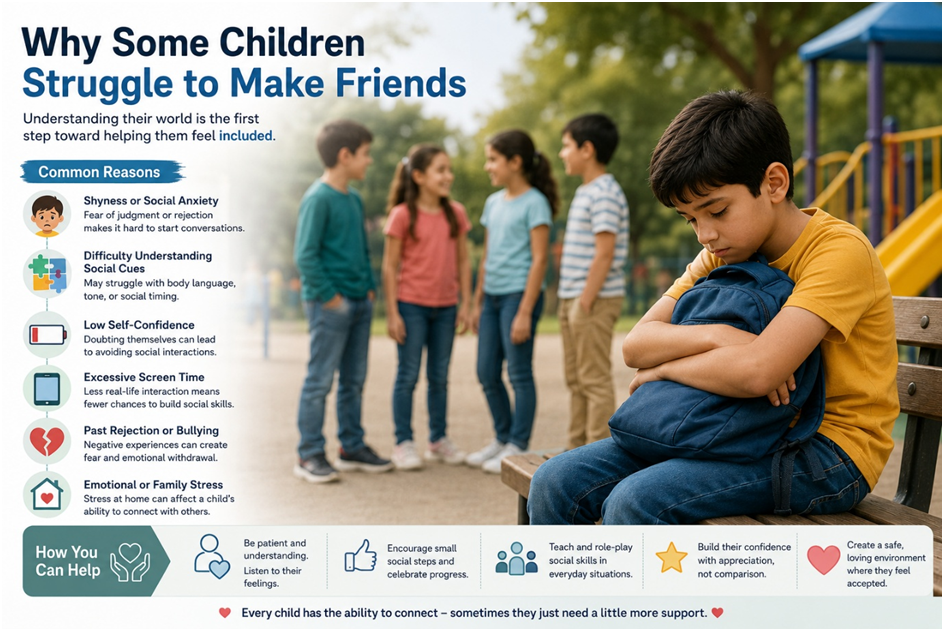
Why Some Children Struggle to Make Friends
Understanding Their World Is the First Step Toward Helping Them Feel Included
May 29, 2026
Khushboo Saini
Friendships are a big part of childhood. Through friendships, children learn how to communicate, share, trust, handle emotions, solve conflicts, and feel accepted. For many kids, making friends happens naturally. But for some children, even small social situations can feel difficult and overwhelming.
Some children stay quiet in groups, avoid joining games, or spend most of their time alone even when they want connection. Parents often notice these things slowly. Maybe their child avoids birthday parties, sits alone during school events, or comes home saying, "Nobody wants to play with me."
At first, many adults assume the child is just shy. And sometimes that's true. But in many cases, there are deeper emotional, social, or psychological reasons behind these struggles.
The important thing to understand is this: a child who struggles socially is not "problematic" or "weird." Often, they simply need more emotional safety, confidence, and support than other children.
1. Shyness and Social Anxiety
Some children naturally take more time to feel comfortable around people. They like observing first before speaking or joining activities. That kind of personality is completely normal. But for some children, it goes beyond shyness. They may constantly worry about being judged, embarrassed, or rejected. Even simple situations can feel stressful for them.
Before walking up to another child, their mind may already be filled with thoughts like:
- "What if they ignore me?"
- "What if I say something stupid?"
- "What if they laugh at me?"
Because of this fear, they may avoid social interaction completely.
For example, you might notice a child standing near a group during recess, wanting to join, but never actually stepping forward. Not because they don't care — but because anxiety makes them overthink every small interaction.
Over time, this fear can slowly affect their confidence and make loneliness even stronger.
2. Difficulty Understanding Social Cues
Some children genuinely struggle to understand social behavior. They may find it hard to read facial expressions, understand tone of voice, notice body language, or recognize when someone feels uncomfortable. This can create problems in friendships without the child even realizing it.
For instance, a child may interrupt conversations repeatedly because they are excited and impulsive, while other children may see it as rude or annoying. Another child may continue talking about their favorite topic without noticing others have lost interest. These situations are common in children with ADHD or Autism Spectrum Disorder, but they can also happen in children who are still developing social awareness.
Parents sometimes notice things like:
- Their child struggles with turn-taking
- They become overwhelmed in groups
- They speak very loudly without realizing it
- They have trouble understanding jokes or sarcasm
The child is usually not trying to upset others. In many cases, they simply do not fully understand social timing yet.
3. Low Self-Confidence
Children who constantly doubt themselves often struggle to build friendships too.
When a child already believes:
- "I'm boring."
- "Nobody likes me."
- "I'm different."
- "I'm not good at talking."
they start expecting rejection even before social interaction begins.
Low confidence can develop slowly through repeated experiences like:
- Being criticized too often
- Academic struggles
- Bullying
- Feeling ignored
- Constant comparison with siblings or classmates
Sometimes parents unintentionally hurt a child's confidence without realizing it. Statements like:
"Look how confident your brother is,"
or
"Why are you always so quiet?"
may seem small, but children absorb these messages deeply.
You may notice these children wanting to participate but holding themselves back at the last moment. They avoid eye contact, speak very softly, or let others decide everything because they are scared of doing something wrong.
4. Too Much Screen Time and Less Real Interaction
Today's children are growing up in a world where screens are everywhere. Phones, tablets, video games, and social media have become part of daily life.
Technology itself is not the problem. The problem starts when screen time replaces real-life interaction.
Children learn social skills through actual experiences:
- Playing together
- Sharing toys
- Solving disagreements
- Reading facial expressions
- Waiting for turns
- Handling emotions face-to-face
A child who spends most of their free time online may get fewer opportunities to practice these important skills.
Some parents notice that their child talks comfortably while gaming online but becomes extremely awkward during real conversations. Others notice frustration, impatience, or emotional outbursts during normal social interaction because the child is not used to handling real-world communication.
5. Bullying or Past Rejection
Children remember painful social experiences more deeply than adults sometimes realize. Being laughed at in class, getting excluded from games repeatedly, or hearing hurtful comments can leave a strong emotional impact. After repeated rejection, many children stop trying altogether.
Instead of saying:
"My feelings are hurt,"
they may start saying:
- "I don't care about friends."
- "People are annoying."
- "I'd rather stay alone."
But many times, this emotional distance is actually self-protection.
For example, a child who was once excited to attend school may suddenly start avoiding group activities after being teased by classmates. Parents may notice mood changes, irritability, or emotional withdrawal without understanding the real reason behind it.
6. Emotional Stress at Home
Children are deeply affected by the emotional environment around them. Even when adults think children "don't understand," kids often absorb stress quietly.
Things like:
- Constant arguments at home
- Divorce or separation
- Emotional neglect
- Harsh parenting
- Feeling emotionally unsafe
can affect a child's ability to trust and connect with others.
A child who feels emotionally unsupported at home may become withdrawn, sensitive, angry, or fearful in social situations too. Sometimes these children become extremely reactive in friendships because they are already emotionally overwhelmed internally.
7. Feeling Different From Others
Not every child enjoys loud groups, sports, or constant social activity.
Some children enjoy quieter hobbies like:
- Drawing
- Reading
- Building things
- Art
- Music
- Science activities
And that is completely okay.
The problem happens when children start feeling isolated because they cannot find peers who understand or relate to them.
For example, a child who loves books and creative activities may struggle to connect with classmates who only talk about sports or gaming. Slowly, they may start feeling like they "don't fit in."
That feeling of being different can affect self-esteem more than adults realize.
How Parents and Adults Can Help
Children who struggle socially usually do not need pressure or lectures. They need understanding, patience, and emotional support.
Encourage Without Forcing
Forcing a child into uncomfortable social situations often increases anxiety instead of building confidence.
Small steps work better.
Sometimes even encouraging one short conversation or one play interaction is enough for progress.
Teach Social Skills Naturally
Social skills can be practiced during everyday moments:
- Teaching greetings
- Practicing eye contact
- Role-playing conversations
- Encouraging listening and turn-taking
Children learn best when they feel safe, not judged.
Validate Their Feelings
One of the biggest mistakes adults make is dismissing a child's emotions.
Instead of saying:
"Just go make friends."
Try saying:
"I know this feels hard for you sometimes."
Feeling emotionally understood helps children feel safer socially too.
Avoid Constant Comparisons
Comparing children to siblings, cousins, or classmates can quietly damage confidence. Every child develops socially at a different pace. Some children need more time, support, and reassurance — and that's okay.
Create Safe Social Opportunities
Large groups can feel overwhelming for socially anxious children.
Smaller environments often help more:
- Hobby classes
- Art groups
- Structured activities
- One-on-one playdates
Children usually open up faster when they feel emotionally comfortable.
Seek Professional Support if Needed
If a child consistently avoids interaction, experiences intense anxiety, emotional meltdowns, or struggles heavily with communication and emotional regulation, professional support can help.
Sometimes the child is not "anti-social" at all. They may simply be emotionally overwhelmed, anxious, or struggling with an underlying condition like ADHD, autism, or anxiety disorder.
Final Thoughts
Every child's social journey looks different.
Some children make friends easily. Others need more time, emotional support, and reassurance before they feel safe enough to connect.
A child struggling socially is not weak, rude, or abnormal.
Many times, they are quietly dealing with fear, overthinking, low confidence, emotional hurt, or the feeling that they simply do not belong.
And honestly, sometimes one emotionally safe environment, one understanding adult, or even one genuine friendship can completely change how a child sees themselves.
Children don't need to become socially "perfect." They simply need to feel accepted for who they are.
By Khushboo Saini
Contact Info
Chandigarh, India
9817303032
officialmanoshala@gmail.com
© 2026 Manoshalaa. All rights reserved.
Developed by TerraDigitalize Dynamics