
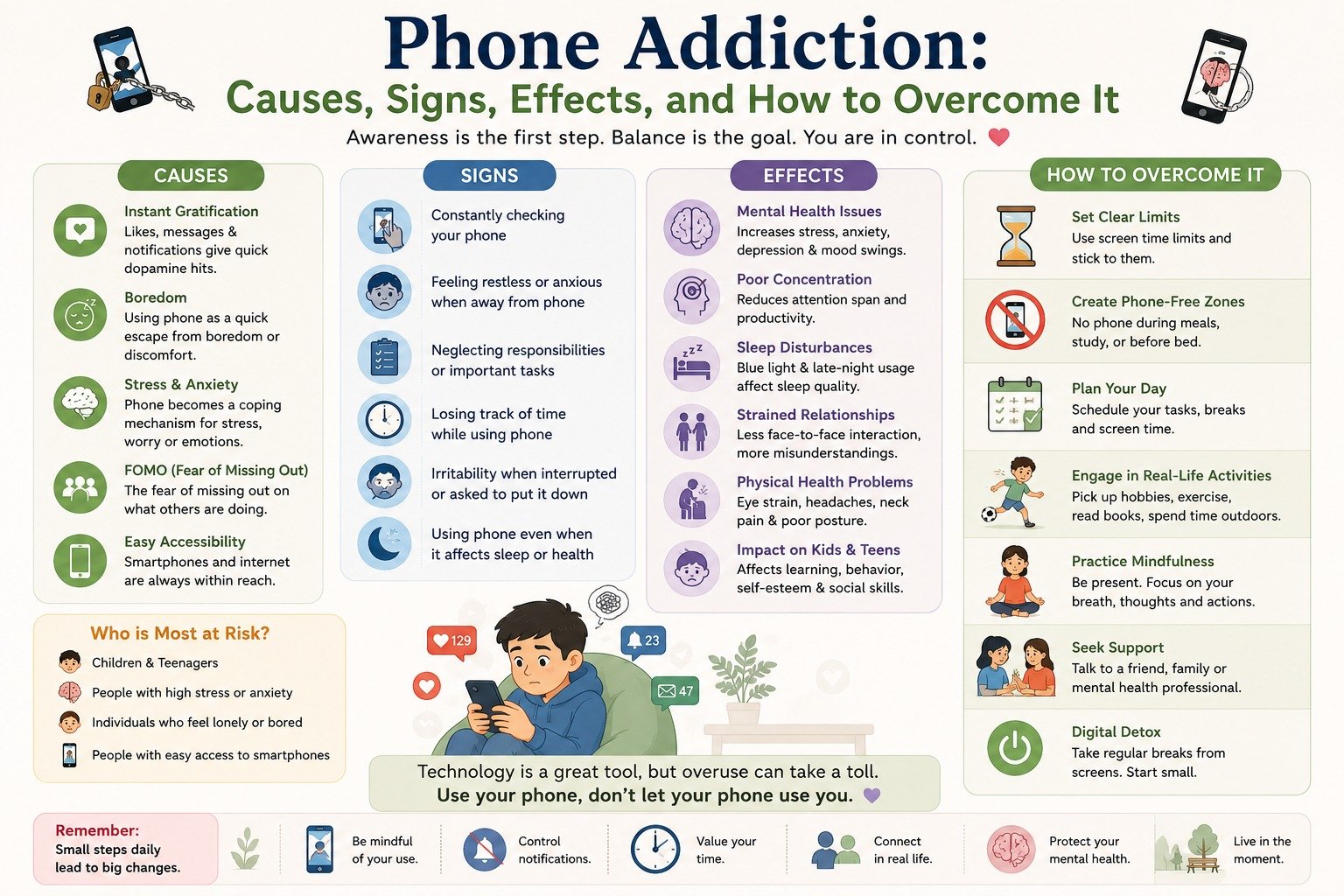
Phone Addiction: Causes, Signs, Effects, and How to Overcome It
Finding Balance in a Digital World
May 19, 2026
Khushboo Saini
Introduction: Is Your Phone Controlling You?
In today's digital age, smartphones have become an essential part of our lives. From talking to someone to having a laugh, everything is just a click away. However, excessive phone use is becoming a growing concern, a condition known as phone addiction.
Many people check their phones without any reason. While this may start as a simple habit, it gradually becomes dependent, negatively impacting our mental health, physical health, and relationships.
What is Phone Addiction?
Phone addiction, also known as problematic smartphone use, has negative impacts on our lives every day, yet we continue to use our phones excessively. Psychologists say it's a behavioural pattern where our brains become addicted to notifications, messages, calls, and being active on social media.
When they do all this, their brain gets temporarily happy, which lasts only for the time they are using the phone, and their brain considers this temporary happiness as permanent.
Causes of Phone Addiction
There are many reasons why people become addicted to their phones:
- Dopamine Reward System: When we repeatedly see notifications or likes, our brain starts releasing dopamine, which is a happy hormone, which makes us want to repeat that behavior again and again and we become happy, and later on, this behavior becomes such a habit that we either feel scared or irritated when we leave it.
- Impact of Social Media: Social media is designed to keep people active for as long as possible. When we see others' lives, achievements, or lifestyles, we unconsciously compare ourselves to them. This often leads to feelings of inferiority (low self-esteem) or dissatisfaction. Furthermore, likes, comments, and shares provide a form of social validation, which motivates us to check our phones repeatedly.
- Fear of missing out (FOMO): This is the fear that we might miss something important, interesting, or urgent. A person repeatedly feels that if they don't check their phone, they'll miss an update, message, or event. When they see other people's posts, achievements, or social activities, they tend to think, "Everyone's life is going better than mine," or "I'm missing out." This thought gradually leads to restlessness and anxiety, which leads them to repeatedly checking their phone even when unnecessary.
- Stress and escapism: Nowadays, many people have started taking the help of phone to escape from their daily stress, pressure or emotional problems. When people are stressed, anxious or in any trouble, they find it better to use the phone rather than facing the real problem, and try to escape from it by spending time on the phone.
It is very important for all of us to know that social media, reels, games or videos provide a temporary distraction, which makes the mind feel light for some time. But this relief is only for a short time, whereas the real problem remains the same, and later the stress starts getting felt even more.
- Boredom: Nowadays, whenever we are free, we prioritize our phones because they keep updating with something new every day. When people feel bored, they immediately pick up their phones because they provide instant entertainment. Gradually, the brain becomes accustomed to this pattern, causing people to ignore real-life or physical health activities, which can lead to many health problems.
Signs and Symptoms of Phone Addiction
If anyone around you is showing these symptoms, then he/she may be suffering from phone addiction.
- When he repeatedly checks his phone for no reason.
- When he feels uneasy or nervous without his phone.
- When he spends most of his day on the phone.
- When he is having trouble concentrating on work or studies.
- When he ignores life conversations and responsibilities.
Effects of Phone Addiction on Mental and Physical Health
Mental Health Effects
Excessive phone use has a negative impact on our mental health. Constant comparisons on social media can lead to anxiety, stress, and a decreased ability to concentrate.
Physical Health Effects
Staring at the screen for a long time causes pain in the eyes, which also causes problems in sleeping. On the other hand, our head also starts aching and the neck also gets strained, due to which we later experience cervical pain and problems like back pain also occur.
Impact of Phone Addiction on Daily Life
Phone addiction affects our personal and professional growth, our relationships, and our lifestyles. When we use our phones excessively, we gradually start procrastinating and stop paying attention to our physical and mental health. This reduces communication and weakens emotional connections. This distance gradually leads to misunderstandings and dissatisfaction.
Ultimately, phone addiction disconnects us from real-life experiences, leaving us lost in our screens instead of enjoying the things, people, and moments around us. This disrupts life's balance, and a person gradually begins to feel disconnected.
How to Overcome Phone Addiction
1. Set Screen Time Limits
Often, we ourselves don't realize how many hours a day we spend using our phones. Setting a screen time limit is an effective way to control this behavior. Nowadays, most smartphones have built-in features, such as screen time or digital wellbeing, that track daily usage. Through these, you can see how much time you spend on which app and set limits as needed. This gradually reduces the habit of using your phone repeatedly without thinking.
The most important thing is to start with small steps. For example, if you use your phone for 6-7 hours, gradually reduce it to 4-5 hours. This will not only put pressure on your mind but will also lead to a sustainable change in your habits.
2. Turn Off Unnecessary Notifications
Many times we must have noticed that the constant notifications on our phone - messages, social media updates, emails - distract our attention again and again. Every notification becomes a small interruption, which breaks our focus. We can be busy working or studying, but even a small notification immediately pulls us towards the phone. An easy way to reduce this distraction is to turn off unnecessary notifications. This does not mean that you turn off all notifications, but just limit the notifications of those apps which are not necessary - like social media alerts, promotional messages or random app updates.
3. Create No-Phone Zones
Another very effective way to reduce phone addiction is to designate certain times and places throughout your day where you absolutely cannot use your phone. These are called "no-phone zones." This means that in certain situations—like while eating, before bed, or while talking to someone—we consciously distance ourselves from our phones. When we create no-phone zones, we give our brains a break. This improves focus, sleep quality, and strengthens relationships. This may seem a little difficult at first, but gradually it becomes a healthy habit.
4. Replace Screen Time with Healthy Activities
We can avoid becoming phone addicts if we don't just try to reduce phone use, but instead consciously incorporate some meaningful and healthy activities into our routine. When we spend time with family or friends without distraction, the emotional connection strengthens and we experience real-life happiness. This change may seem a little challenging in the beginning, but as we adopt alternative activities, our dependency on the phone automatically starts reducing.
5. Practice Mindfulness
Mindfulness means paying attention to whatever you're doing with complete awareness. Instead of mindlessly using your phone, consciously understand when, why, and how much you're using it. Mindfulness helps us recognize this pattern. Whenever you pick up your phone, ask yourself a simple question: "Do I really need this right now, or am I just using it out of habit?"
Gradually, this awareness grows, and you start making conscious choices instead of impulsively using your phone. This reduces distractions and improves focus.
You can take small steps to practice mindfulness—like taking a few minutes a day to sit without your phone, doing breathing exercises, or focusing on a task without multitasking.
When to Seek Professional Help
When a person is unable to control their phone usage, and it starts affecting their work, studies, relationships or mental health, then it becomes necessary to seek professional help. If you feel that you are unable to reduce your phone usage despite repeated attempts, or if you feel anxiety, irritability or restlessness when you are unable to reach your phone, then this could be a warning sign. Similarly, if your sleep is getting disturbed, productivity is decreasing, or you are becoming isolated from real-life interactions, then you should not ignore it.
Conclusion: Finding Balance in a Digital World
Smartphones have become an essential part of our lives today. They connect us to the world, simplify our work, and provide us with information. But when they become overused, this convenience gradually turns into a habit and then a dependency, which has serious consequences for our mental, physical, and social lives.
So it's not necessary to stop using our phones altogether, but rather to learn to develop a balanced and healthy relationship with them. When we become aware of our phone use, we understand when and why we're using it—then we can gain better control over our time and energy.
By Khushboo Saini
Contact Info
Chandigarh, India
9817303032
officialmanoshala@gmail.com
© 2026 Manoshalaa. All rights reserved.
Developed by TerraDigitalize Dynamics