
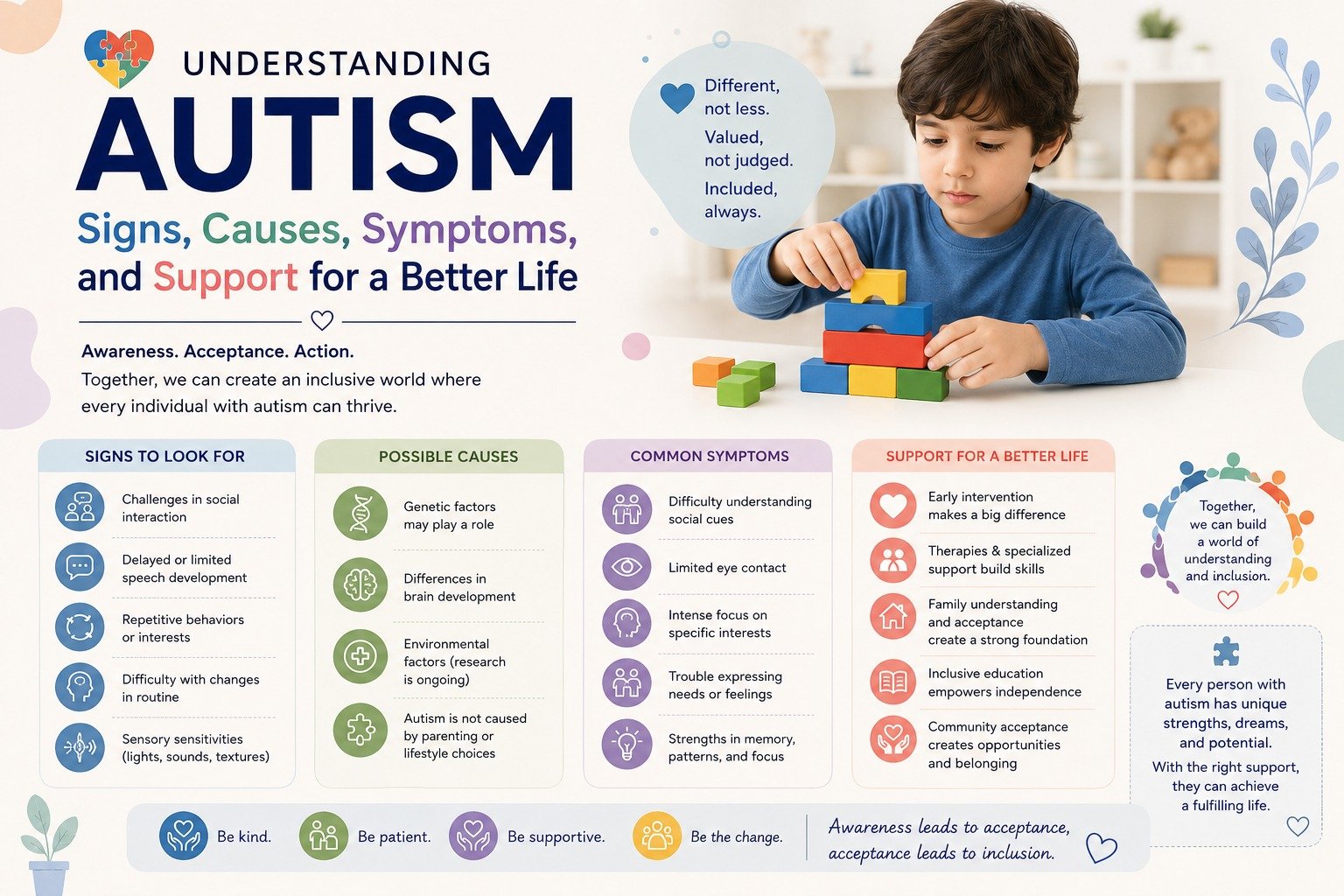
Understanding Autism: Signs, Causes, Symptoms, and Support for a Better Life
Awareness, Acceptance, and Early Support
May 20, 2026
Khushboo Saini
What is Autism?
Autism Spectrum Disorder is a developmental condition that changes the way a person experiences communication, emotions, learning, and social interaction. It usually appears during early childhood and stays throughout life. Autism is known as a "spectrum" because no two autistic individuals are exactly the same. Some people may face challenges in speaking, understanding emotions, or adjusting to changes, while others may be highly independent and successful in different areas of life.
People with autism often think, feel, and respond to the world in their own unique way. Some may enjoy routines, have deep interests in specific topics, or become sensitive to sounds, lights, or crowded places. At the same time, many autistic individuals have amazing qualities such as strong concentration, creativity, honesty, problem-solving skills, and excellent memory.
Autism is not something caused by poor parenting or lack of discipline. It is simply a different pattern of brain development. With understanding, support, and acceptance, autistic individuals can learn, grow, build relationships, and live fulfilling lives.
What does autism look like in adults?
Autism in adults can look different from person to person. Some adults may struggle with social communication, while others may find it difficult to handle change, loud environments, or emotional situations. Many autistic adults may appear quiet, reserved, highly focused, or socially anxious.
Some common signs of autism in adults include:
- Difficulty understanding social cues or conversations
- Feeling uncomfortable in crowded places
- Preferring routines and structure
- Strong interest in specific topics or hobbies
- Sensitivity to noise, lights, or touch
- Finding it hard to express emotions clearly
Many adults discover they are autistic later in life after struggling for years to understand why they feel "different." With awareness and support, autistic adults can build healthy relationships, successful careers, and meaningful lives.
How does autism affect people?
Autism affects every person differently. Some people may have mild challenges, while others may need more daily support. Autism mainly affects communication, social interaction, behavior, and sensory experiences.
An autistic person may:
- Find social situations confusing
- Struggle to express feelings or needs
- Become stressed by sudden changes
- Feel overwhelmed by loud sounds or bright lights
- Prefer routines and familiar environments
At the same time, many autistic individuals also have strengths like creativity, attention to detail, honesty, intelligence, and problem-solving abilities. Autism is not only about challenges — it also includes unique talents and different ways of thinking.
What Causes Autism?
Many parents and families often wonder why autism happens. One of the most important things to understand is that autism is nobody's fault. It is not caused by bad parenting, lack of love, emotional trauma, or watching too much television. Autism is a natural difference in brain development that usually begins before a child is born.
Researchers and doctors still do not know one exact reason behind Autism Spectrum Disorder, but studies suggest that autism develops because of a combination of genetic and environmental factors. This means that both a child's genes and certain conditions during pregnancy or early brain development may play a role.
Genetics are considered one of the biggest factors. Sometimes autism runs in families, which suggests that certain inherited genes may influence how the brain develops and functions. However, having these genes does not guarantee that a child will have autism. It simply increases the possibility in some cases.
Researchers also believe that differences in brain development during pregnancy may contribute to autism. Certain complications during pregnancy or birth, such as premature birth, low birth weight, or exposure to high levels of stress or infections during pregnancy, may slightly increase the chances. Still, these factors alone do not directly "cause" autism.
It is also important to clear up one of the biggest myths related to autism. Scientific research across the world has repeatedly proven that vaccines do not cause autism. This misunderstanding spread many years ago because of false information, but medical experts and health organizations have completely rejected this claim.
Autism can appear in children from all backgrounds, cultures, and economic groups. Some children show signs very early in life, while in others the symptoms become more noticeable as social and communication demands increase with age.
Every autistic person is different, which is why autism is called a spectrum. Some individuals may need significant support in daily life, while others may be highly independent and successful in education, careers, and relationships.
Rather than focusing only on "why" autism happens, experts today encourage families to focus more on understanding the child's needs, strengths, communication style, and emotional well-being. Early support, patience, acceptance, and the right guidance can help autistic individuals grow with confidence and lead fulfilling lives.
How to identify the autism child?
Parents often notice early signs of autism during childhood. Every child develops differently, but some behaviors may suggest that a child needs professional evaluation.
Common signs of autism in children include:
- Delayed speech or communication
- Limited eye contact
- Not responding to their name
- Repetitive movements or behaviors
- Difficulty making friends or socializing
- Strong attachment to routines
- Sensitivity to sounds, lights, or textures
If parents notice these signs consistently, it is important to speak with a child psychologist, pediatrician, or developmental specialist. Early identification and support can help children improve communication, emotional skills, and confidence.
Can my child with autism live a normal life?
Yes, many children with Autism Spectrum Disorder can live happy, meaningful, and successful lives. With the right support, understanding, education, and therapy, autistic children can develop important life skills, build relationships, study, work, and become independent.
Every autistic child is different. Some may need extra support in communication or learning, while others may grow up with very few difficulties. The most important thing is early support, patience, and acceptance from family, teachers, and society.
Autistic children should never be judged only by their challenges. Many have incredible talents, creativity, intelligence, and unique abilities that help them succeed in life.
By Khushboo Saini
Contact Info
Chandigarh, India
9817303032
officialmanoshala@gmail.com
© 2026 Manoshalaa. All rights reserved.
Developed by TerraDigitalize Dynamics