
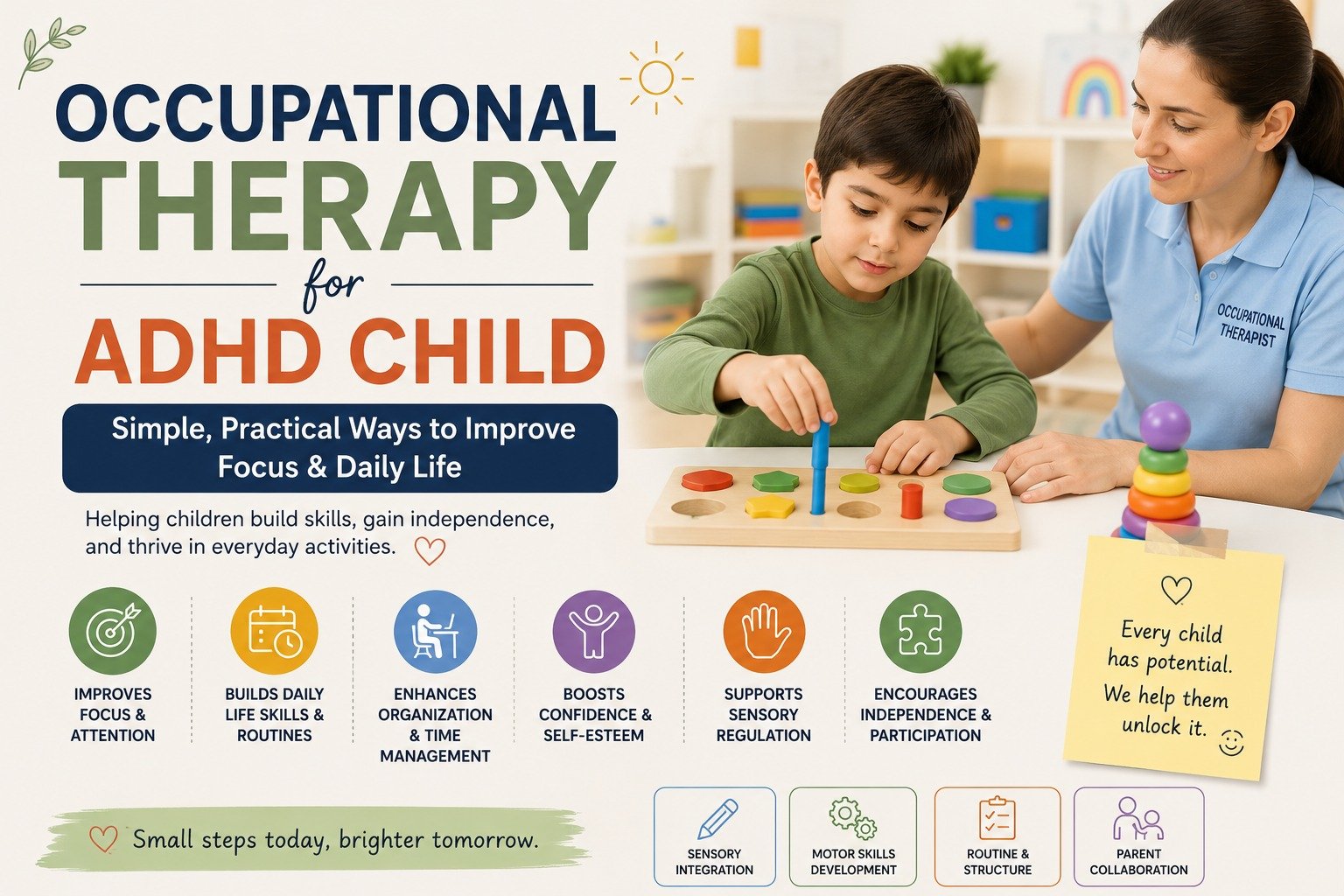
Occupational Therapy for ADHD Child: Simple, Practical Ways to Improve Focus & Daily Life
Home Activities and OT Strategies That Help
May 16, 2026
Khushboo Saini
Understanding ADHD in Children and Why Daily Tasks Feel Difficult
If your child has Attention-Deficit/Hyperactivity Disorder, you've probably noticed that the struggle is not just about studies. Even small things like getting ready for school, sitting for homework, or following simple instructions can turn into a daily battle.
And as a parent, it's exhausting. You keep reminding, they keep forgetting. You ask them to sit, they get up again. After a point, it feels like nothing is working.
The truth is—they are not doing this intentionally. Their brain finds it difficult to manage attention, control impulses, and stay organized. This is exactly where occupational therapy can help in a very practical, real-life way.
ADHD Symptoms in Children (Based on DSM-5 Criteria)
According to the Diagnostic and Statistical Manual of Mental Disorders, Fifth Edition, ADHD symptoms are mainly seen in two areas:
1. Inattention (Focus-related difficulties)
- Your child starts work but doesn't finish it
- Gets distracted very easily, even by small things
- Seems like they are not listening, even when you're talking directly
- Often forgets daily tasks (homework, school items)
- Has difficulty organizing things
2. Hyperactivity & Impulsivity
- Cannot sit in one place for long
- Keeps moving, fidgeting, or touching things
- Talks a lot or interrupts others
- Answers quickly without thinking
- Finds it hard to wait for their turn
These behaviors should be seen for at least 6 months and in more than one place (home + school).
How Occupational Therapy Helps ADHD Children?
1. Helping the Child Sit and Focus (Through Small Activities)
Instead of forcing long study hours, therapists start with short, manageable activities.
What you can do at home:
- Ask your child to sit for just 10 minutes (not more)
- Give one simple task (coloring, puzzle, writing 2 lines)
- Sit nearby in the beginning
- Once done → give a small break
- Slowly increase time to 15–20 minutes
Why this works: The child doesn't feel pressured, so resistance reduces.
2. Managing Extra Energy (So They Can Sit Later)
ADHD children have a lot of physical energy. If you try to stop it completely, it backfires.
What you can do:
Before study time, let them:
- Jump, run, or do light exercise for 10–15 minutes
- Then bring them to sit
Why this works:
Energy gets released first → body feels calmer → sitting becomes easier.
3. Teaching Daily Routine Step by Step
Children with ADHD get confused with multiple instructions.
What you can do:
Instead of saying: "Get ready for school"
Break it like this:
1. Wear uniform 2. Brush teeth 3. Pack bag
You can even make a small chart and stick it on the wall.
Why this works:
Clear steps = less confusion = better follow-through
4. Using Sensory Calming Techniques
Some children get irritated by noise, crowd, or too much stimulation.
What you can do:
- Create a calm corner at home
- Give them a soft toy, cushion, or quiet space
- Reduce noise during study time
Why this works:
When the environment is calm, the brain can focus better.
5. Building Self-Control Slowly
ADHD kids act fast—they don't get time to think.
What you can do:
- Teach them to pause and say: "First work, then play"
- Repeat this with them daily
- Don't expect instant change
Why this works:
With practice, they start controlling their actions little by little.
Occupational Therapy Activities for ADHD Child
1. Heavy Work Activities (For calming the body)
These activities help reduce hyperactivity and improve focus. For example—pushing, pulling, carrying weight.
How to do it:
1. Ask your child to carry a school bag with some books in it 2. Or push a chair/table across the room (safely) 3. You can also ask them to help in small tasks like carrying groceries
Time: 10–15 minutes before study
Why it works:
It gives deep pressure to the body, which naturally calms the brain.
2. Wall Push-Ups (Very simple & effective)
Great for releasing extra energy.
Steps:
1. Make your child stand facing a wall 2. Place both hands on the wall 3. Ask them to push the wall and come back (like push-ups) 4. Repeat 10–15 times
When to use: Before sitting for study
Why it works:
Helps in body control + improves attention after activity.
3. Sensory Play (For focus & calmness)
This is fun and very helpful. For examples: sand play, clay, water play
Steps:
1. Give your child clay or dough 2. Ask them to roll, press, or make shapes 3. Let them explore freely (no strict rules)
Time: 15–20 minutes
Why it works:
It relaxes the mind and improves concentration.
4. Obstacle Course (For attention + planning)
This is like a game, but very powerful.
Steps:
1. Set a simple path at home (chair → pillow → table) 2. Give instructions like: • Jump over pillow • Crawl under table • Walk in a straight line 3. Let them complete the course
Make it fun: Turn it into a race or challenge
Why it works:
Improves focus, listening skills, and body coordination.
5. Visual Schedule / Routine Chart
Helps with daily routine and reduces confusion.
Steps:
1. Make a simple chart: • Wake up • Brush • Eat • School 2. Use pictures or symbols (not just text) 3. Ask the child to tick after completing each task
Why it works:
ADHD kids respond better to what they can see.
6. Timer Method (To improve sitting time)
Very practical for studies.
Steps:
1. Set a timer for 10 minutes 2. Ask your child to focus only till timer ends 3. After that → give 5-minute break 4. Repeat
Gradually increase time
Why it works:
Short time feels manageable, so resistance reduces.
7. Breathing + Calm Down Activity
Helps in emotional control.
Steps:
1. Ask your child to sit comfortably 2. Tell them: "Smell the flower" (inhale) 3. Then: "Blow the candle" (exhale) 4. Repeat 5–10 times
Why it works:
Slows down the body and mind.
8. Sorting & Matching Games (For focus)
Simple but effective.
Steps:
Give mixed objects (colors, shapes, beads)
Ask them to sort (all red together, all blue together)
You can also use cards or pictures
Why it works:
Improves attention span and thinking skills.
9. Balloon Tap Game
Blow a balloon and ask your child to keep it in the air by tapping it.
Set a timer (2–5 minutes).
Helps with: focus + hand control + energy release.
10. Animal Walks
Ask your child to walk like:
- Bear (hands + feet)
- Frog (jumping)
- Crab (backward)
Helps with: body control + strength + attention
11. Clapping Pattern Game
Clap a pattern (like clap–pause–clap)
Ask your child to copy it
Helps with: listening skills + focus
12. Paper Tearing & Pasting
Give old paper
Ask them to tear and paste on a sheet
Helps with: hand strength + calmness
13. Freeze Game
Play music and let them move
Stop music suddenly → they must freeze
Helps with: self-control + impulse control
When Should You Seek Professional Help for ADHD Child?
If your child is struggling in school, daily routine, or social behavior, and things are not improving with basic efforts, it's better to consult a psychologist or occupational therapist.
Early help can prevent bigger issues later.
Supporting Your ADHD Child in the Right Way
Your child is not lazy or careless—they just need a different approach. Occupational therapy doesn't try to "change" the child, it helps them manage life better in their own way.
With patience, consistency, and the right support, you will start seeing small changes—and those small changes matter a lot.
Get Help for Your Child Today
If you feel your child needs guidance with focus, behavior, or daily routine, don't wait. Reach out for professional support and take the first step towards helping your child feel more confident and settled.
Now let's come to the real question: What actually helps?
Occupational therapy focuses on improving daily life skills—not just sitting and studying.
By Khushboo Saini
Contact Info
Chandigarh, India
9817303032
officialmanoshala@gmail.com
© 2026 Manoshalaa. All rights reserved.
Developed by TerraDigitalize Dynamics