
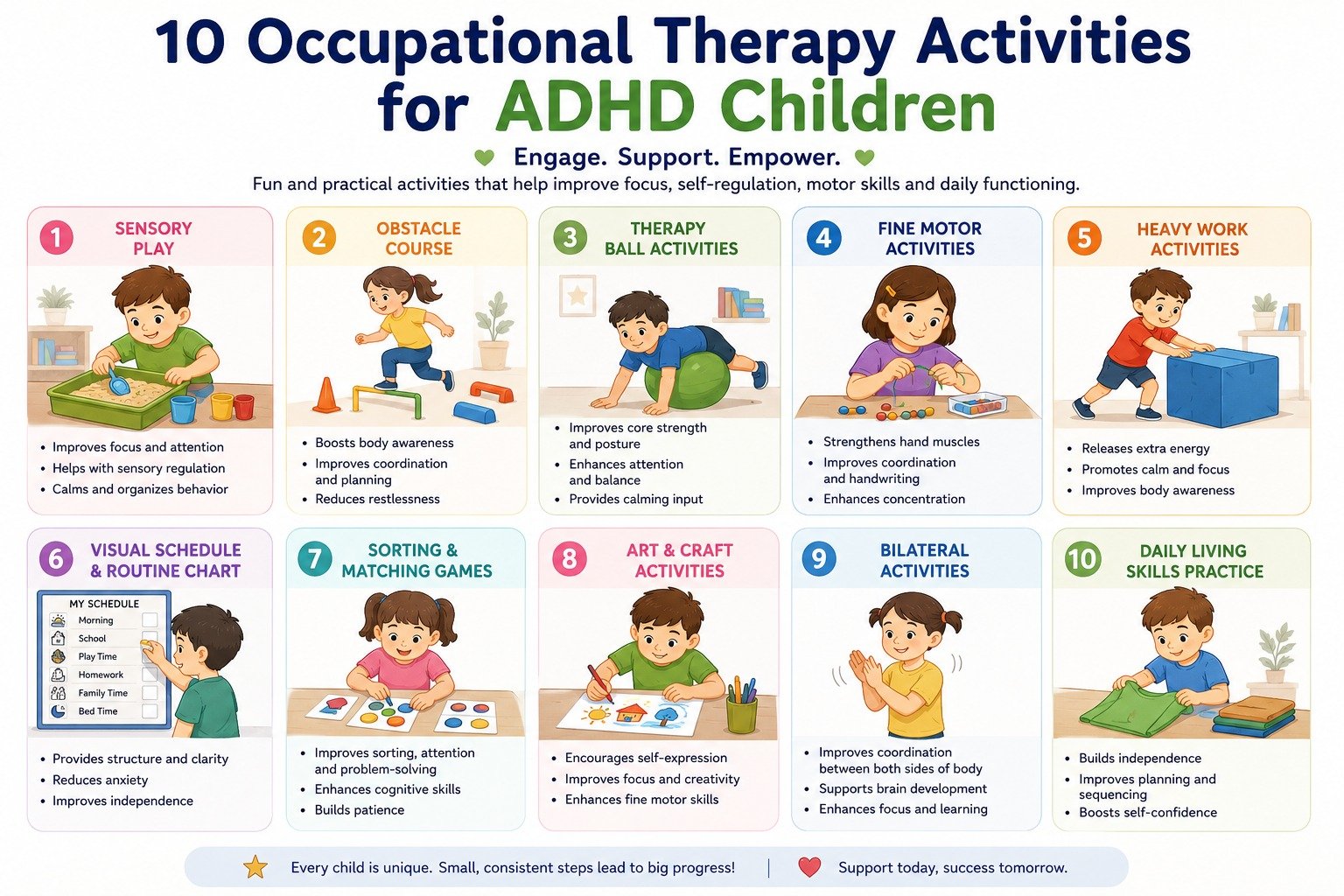
10 Occupational Therapy Activities for ADHD Children
ADHD in India and Practical OT Activities That Work
May 17, 2026
Khushboo Saini
ADHD in India: Understanding the Growing Numbers and the Reasons Behind It
According to different studies and reports referred to by organizations like the World Health Organization (WHO), around 5–7% of children in India are believed to show symptoms related to Attention Deficit Hyperactivity Disorder (ADHD). However, mental health professionals often feel that the actual number could be even higher because many children are still not properly diagnosed or understood.
In India, ADHD is still misunderstood in many families and schools. A child who is unable to sit quietly, forgets instructions, talks excessively, or struggles to focus is often labeled as "naughty," "careless," or "undisciplined." Because of this, many parents do not realize that the child may actually need psychological support instead of punishment.
At the same time, modern lifestyle changes have also made attention-related difficulties more noticeable. Increased screen time, lack of outdoor activities, academic pressure, irregular sleep schedules, and constant exposure to digital content can make it harder for children to manage focus and self-control. These factors may not directly cause ADHD, but they can increase the challenges faced by children who already struggle with attention and impulsivity.
How Occupational Therapy Activities Help Children with ADHD
Children with ADHD usually find it difficult to stay focused for long periods, follow routines, control impulsive behavior, or sit in one place quietly. Because of these challenges, even simple daily tasks like completing homework, listening carefully, or managing emotions can sometimes become stressful for them.
Occupational therapy activities are designed in a way that helps children learn naturally through movement, play, and everyday experiences. Instead of forcing a child to "just concentrate," occupational therapists create activities that match the child's energy level and interests. This makes the child feel more comfortable, involved, and less pressured during therapy sessions.
The best part about occupational therapy is that it focuses on progress in a very practical way. Small improvements, like following instructions properly, sitting calmly for a few extra minutes, or completing a task independently, are treated as meaningful achievements. Over time, these small changes can make a big difference in the child's confidence, behavior, and overall daily functioning.
Instead of forcing children to sit still for long periods, occupational therapists use movement-based, sensory, and creative activities that help children learn while staying active and interested. These activities gradually improve concentration, coordination, emotional control, and independence in daily life.
1. Movement Break Activities
Children with ADHD often struggle to sit in one place for long periods. Occupational therapists therefore include short movement breaks between tasks to help children release extra energy. Activities such as stretching, jumping, dancing, or animal walks are used for a few minutes before returning to the main activity. These breaks help children feel refreshed and improve their ability to concentrate afterward. Instead of treating movement as a distraction, occupational therapy uses it as a tool to improve attention and self-regulation.
2. Art and Craft Activities
Art and craft activities allow children with ADHD to express emotions creatively while improving patience and attention. Therapists may encourage children to draw, paint, color, or create simple crafts using paper and other materials. While working on these activities, children learn to focus on one task at a time and complete it patiently. Creative activities also reduce stress and help children express thoughts and feelings that they may find difficult to communicate verbally.
3. Deep Breathing Exercises
Deep breathing exercises are used to help children manage impulsive behavior, frustration, and emotional outbursts. Therapists guide children to sit calmly and take slow deep breaths through the nose before slowly breathing out through the mouth. Sometimes breathing activities are turned into fun exercises, such as pretending to blow up a balloon or slowly blowing bubbles. These techniques help slow down the child's thoughts and body movements, making it easier for them to relax and regain focus during stressful situations.
4. Fine Motor Skill Activities
Some children with ADHD experience difficulty with handwriting, buttoning clothes, holding pencils properly, or using scissors. Occupational therapists use fine motor activities such as clay work, coloring, bead threading, and paper folding to strengthen hand muscles and improve coordination.
These activities may look simple, but they play an important role in helping children perform school and self-care tasks more independently.
5. Visual Schedule Activities
Children with ADHD often find it difficult to remember routines or stay organized throughout the day. Visual schedule activities help by providing structure through charts, pictures, or checklists. Occupational therapists may create simple routines showing tasks such as brushing teeth, packing a school bag, or completing homework. As children finish each task, they mark it on the checklist. This process helps children understand routines more clearly, reduces confusion, and gradually teaches responsibility and independence.
6. Balance and Swing Activities
Balance and swing activities are frequently used to improve sensory regulation and body awareness. Occupational therapists may use swings, therapy balls, or balance beams to help children practice controlled body movements. Swinging slowly or balancing carefully helps children feel calmer and improves concentration. These activities are especially useful for children who are hyperactive or constantly moving because they provide the sensory input the child's body needs in a controlled and safe way.
7. Memory and Attention Games
Memory and attention games help children strengthen concentration and mental focus. Occupational therapists use activities such as matching cards, puzzles, memory sequences, or pattern games where children are required to pay close attention and remember information. These games encourage children to focus for longer periods while also improving problem-solving and working memory skills. Since the activities feel playful rather than academic, children are usually more motivated to participate actively.
8. Social Skills Activities
Social skills activities help children learn how to communicate and interact appropriately with others. Occupational therapists often use role-play games and group activities to teach children how to wait for their turn, listen carefully, share things, and express emotions calmly. Through guided practice, children become more confident in social situations and gradually improve their relationships with peers, teachers, and family members.
9. Obstacle Course Activities
Obstacle course activities are very helpful for children with ADHD because they allow them to release extra energy in a structured and purposeful way. Occupational therapists create simple courses using cushions, cones, ropes, or chairs, where children may be asked to jump, crawl, balance, or move around obstacles step by step. While performing these activities, children learn to follow instructions carefully and control their body movements. These exercises improve balance, coordination, attention, and listening skills while also making physical activity enjoyable.
10. Sensory Play Activities
Sensory play activities are commonly used in occupational therapy to help children calm their minds and improve focus. Therapists often use materials such as rice, sand, beads, or soft objects placed inside a sensory bin. Small toys or objects are hidden inside, and the child is encouraged to search for them slowly using their hands. This activity helps children process sensory information more effectively while also improving attention span and patience. For children who feel restless or overstimulated, sensory play creates a calming effect and helps them feel more organized emotionally and physically.
How Occupational Therapy Supports Children with ADHD in Daily Life
Occupational therapy techniques are designed to support the child in a practical, supportive, and child-friendly way. Instead of focusing only on symptoms, these techniques help children improve everyday functioning, emotional balance, focus, coordination, and confidence. With regular practice and support from parents and teachers, occupational therapy can make a meaningful difference in the overall development of a child with ADHD.
By Khushboo Saini
Contact Info
Chandigarh, India
9817303032
officialmanoshala@gmail.com
© 2026 Manoshalaa. All rights reserved.
Developed by TerraDigitalize Dynamics