
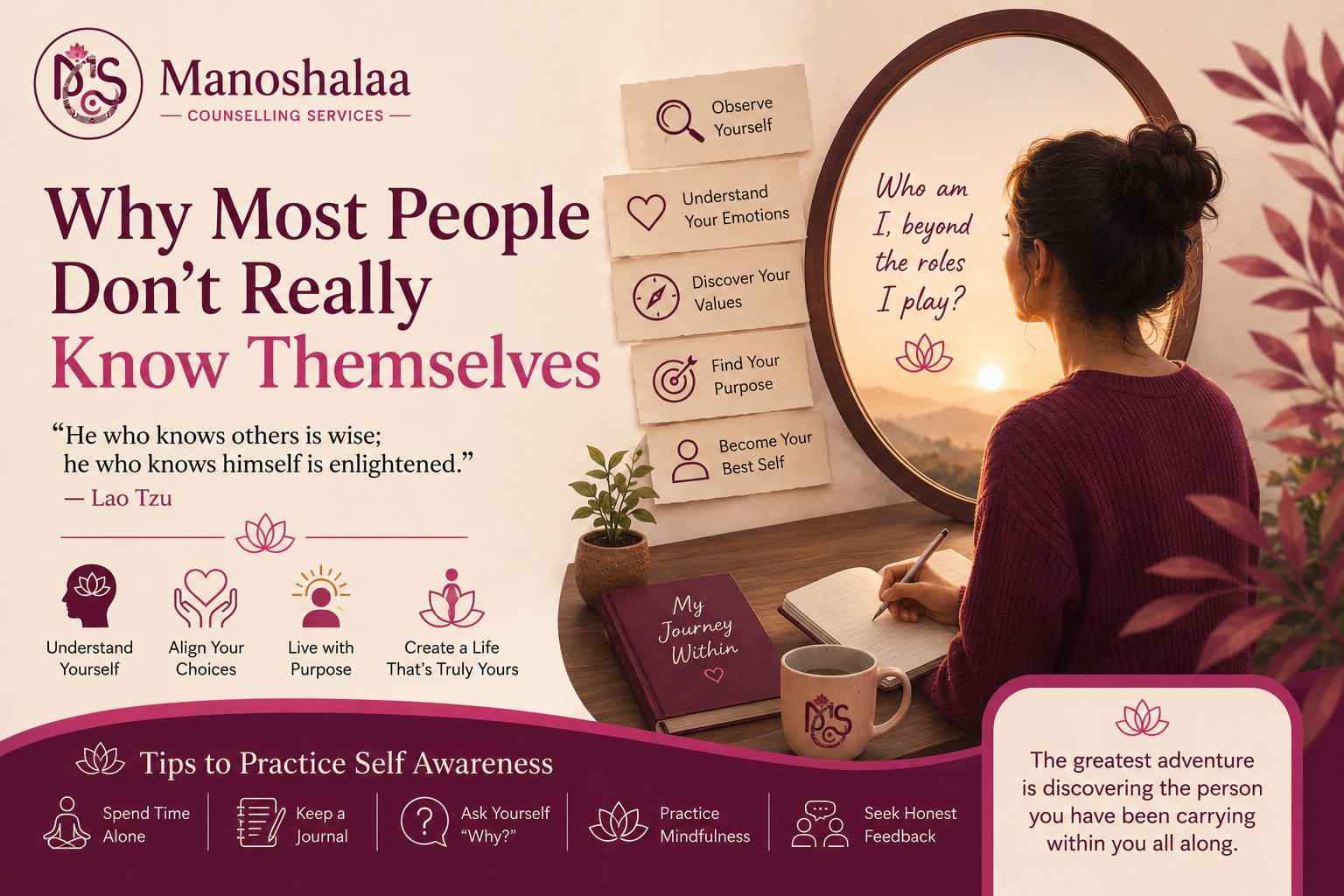
Why Most People Don't Really Know Themselves
"He who knows others is wise; he who knows himself is enlightened." — Lao Tzu
Aug 18, 2026
Manoshalaa
People begin to make conventional choices about a child's future as soon as they are born, even while they are still in the cradle. "My son will become a doctor," "My daughter will be an engineer," and many more career paths are envisioned by parents with delight. Expectations are set by society long before a child establishes their own passions, aspirations, or personality.
Yet, amidst all these aspirations, one crucial lesson is almost always missing: before deciding what we want to become, we must first understand who we are.
We teach young ones how to read, write, compete, and succeed, but we seldom ever teach them how to recognize their emotions, uncover their strengths, confront their beliefs, or find their own passions. Because of this, a lot of people spend years pursuing occupations and objectives that are chosen for them, only to discover later that they never really knew who they were.
Although being an essential aspect of life, self-awareness is not emphasized. People are aware of their names, occupations, interests, and even their preferred cuisine. They are aware of how other people characterize them. Beneath these titles, though, comes a more significant question: When all the designations fade away, who are you?
From the story of womb to tomb, our lives are shaped by external influences. Parents tell us what is right and wrong. Teachers tell us what success looks like. Society defines intelligence through grades, popularity through followers, and achievement through salaries. We see the mirror and judge our outer selves—but do we really reflect on our inner selves?
We often choose careers based on parents' decisions because they are "safe," but do we truly realize whether this particular profession is meant for us? Students chase goals because everyone else is doing the same—but in that race, do we question ourselves: is it really needed?
We all compare ourselves with strangers on social media and seek approval instead of authenticity.
Eventually, we become experts at playing roles—but strangers to ourselves.
Social media influencers tell us how to dress. Podcasts tell us how to think. Motivational speakers tell us how to succeed. Friends tell us what we should become. Algorithms constantly suggest what we should watch next.
But very few moments are left for silence.
Self-awareness requires reflection, and reflection requires space. If your mind is constantly occupied with notifications, videos, reels, and endless scrolling, when will you ever hear your own thoughts?
We have time to listen to someone else's thoughts, but we don't provide ourselves the space to listen to us. The loudest voice in your life should be your own conscience—neither internet nor society.
Let's perform an experiment.
Ask someone, "Who are you?"
Most people respond with their occupation. "I'm a software engineer." "I'm a doctor." "I'm a student." "I'm an entrepreneur."
Nobody really knows who they truly are—what they really need is self-reflection, positive attitude, empathy, and self-confidence. Knowing yourself means understanding your values, principles, fears, strengths, weaknesses, motivations, and purpose—not merely your résumé.
Self-awareness is not easy to practice, and it's not always pleasant. Looking inward often reveals uncomfortable truths. Self-awareness can show how insecure you are underneath your confidence—and how your confidence may depend on validation. It may reveal how anger hides disappointment, and how our ambition is driven by comparison rather than passion.
Many people believe that reaching success will automatically bring happiness and fulfillment. Yet history is filled with successful individuals who experienced burnout, anxiety, identity crises, or deep dissatisfaction.
You may ask: why? Because external success cannot compensate for internal confusion. Without understanding yourself, every achievement becomes temporary. Self-awareness teaches us that fulfillment isn't found merely in achieving more—it is found in becoming more conscious of who we already are.
TIPS TO PRACTICE SELF AWARENESS
- Spend Time Alone Every Day
- Keep A Journal
- Ask Yourself "Why?"
- Practice Mindfulness
- Seek Honest Feedback
Spend time alone to hear your own thoughts without external influence. Even 15–20 minutes of quiet reflection each day can help you understand your emotions, desires, and priorities.
Keep a journal: What made me happy today? What frustrated me? What did I learn about myself? Did I act according to my values?
Ask "Why?" whenever you make an important decision—or feel strong emotion. Why did I react this way? Why is this important to me?
Practice mindfulness by observing your thoughts without immediately reacting. Meditation, breathing exercises, or simply paying attention to the present moment can increase awareness of your inner world.
Seek honest feedback from trusted friends, mentors, or family: "What's one strength I should build on, and one blind spot I should work on?"
We can also take help from counselling psychologists in India; they can help immensely to understand who we truly are. Counselling psychologists play an important role in realizing how we can sync our inner world and outer world.
As Socrates famously encouraged centuries ago: "Know thyself."
Perhaps the greatest adventure is not traveling across the world or climbing the highest mountain. Perhaps the greatest adventure is discovering the person you have been carrying within you all along.
By Manoshalaa
Contact Info
Chandigarh, India
9817303032
officialmanoshala@gmail.com
© 2026 Manoshalaa. All rights reserved.
Developed by TerraDigitalize Dynamics