
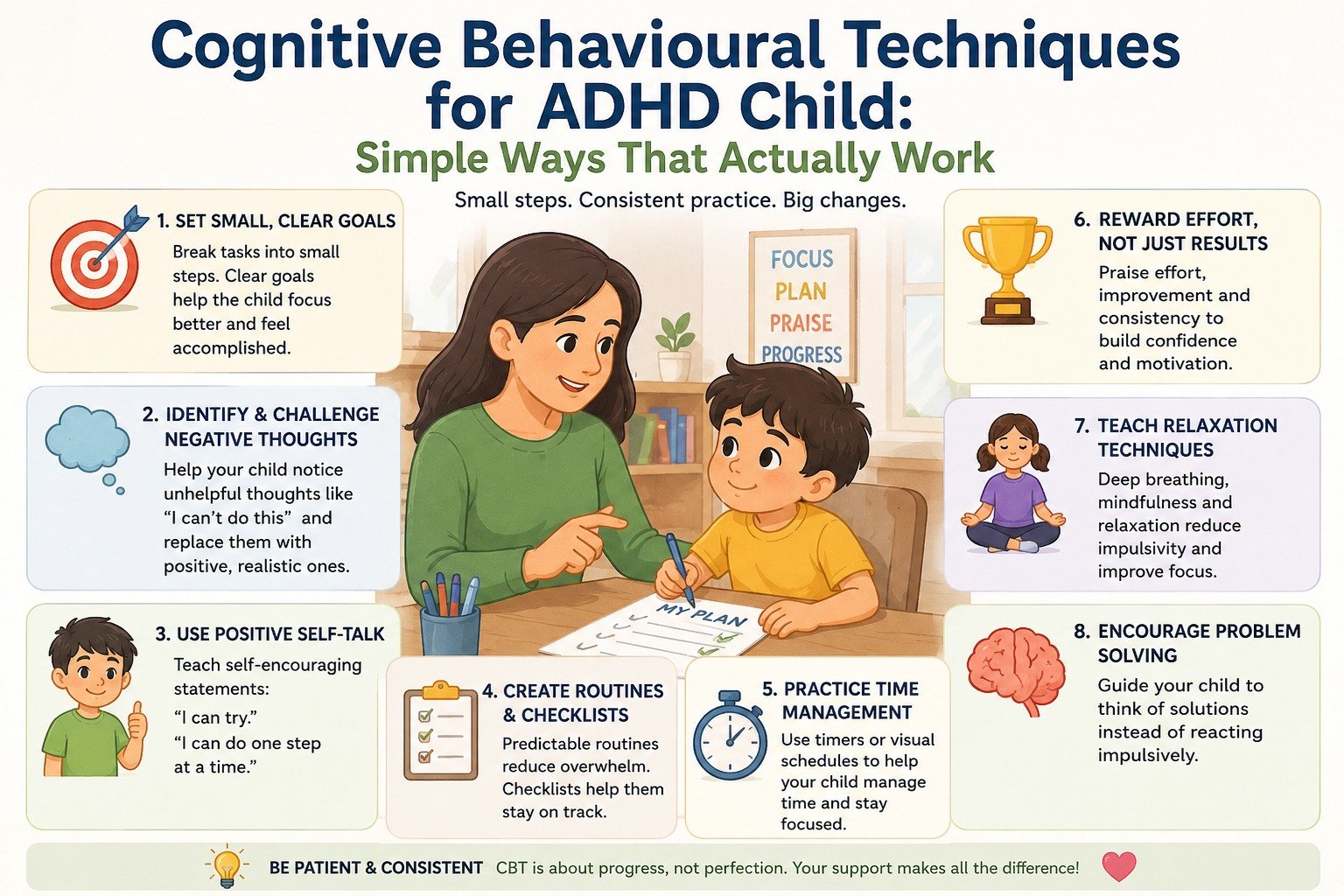
Cognitive Behavioural Techniques for ADHD Child: Simple Ways That Actually Work
Practical CBT-Based Strategies for Parents
May 12, 2026
Khushboo Saini
Understanding ADHD in Children: Why Early Support Matters
Parenting a child with Attention-Deficit/Hyperactivity Disorder (ADHD) can feel like a daily challenge. One moment they are full of energy, and the next moment they can't focus on even simple tasks. Many parents feel confused, frustrated, or even helpless—but the truth is, your child is not being difficult on purpose. Their brain simply works differently.
The good news is that with the right guidance, you can support your child in a very practical way. Cognitive Behavioural Techniques (CBT-based strategies) are simple, structured methods that help children manage their thoughts and actions. These techniques don't require complicated tools—just patience, consistency, and understanding.
ADHD Symptoms in Children According to DSM-5 (Inattention & Hyperactivity)
According to the Diagnostic and Statistical Manual of Mental Disorders, Fifth Edition, ADHD symptoms fall into two main categories:
1. Inattention (Focus-related difficulties)
- Often makes careless mistakes in schoolwork
- Has trouble sustaining attention (e.g., during studies or tasks)
- Seems not to listen when spoken to directly
- Frequently does not finish tasks or assignments
- Has difficulty organizing tasks and activities
- Avoids tasks that require mental effort (like homework)
- Often loses things (books, stationery, etc.)
- Easily distracted by surroundings
- Forgetful in daily activities
2. Hyperactivity & Impulsivity
- Often fidgets or cannot sit still
- Leaves seat in situations where staying seated is expected
- Runs or climbs in inappropriate situations (in younger children)
- Has difficulty playing quietly
- Talks excessively
- Blurts out answers before questions are completed
- Has difficulty waiting for their turn
- Interrupts or intrudes on others (e.g., in conversations or games)
These symptoms should be present for at least 6 months and seen in multiple settings like home and school.
Effective Cognitive Behavioural Techniques to Manage ADHD in Children
1. Break Tasks into Small Steps
Honestly, one of the biggest mistakes we make is giving kids a big instruction like "Finish your homework." For an ADHD child, that already feels too much.
Try this instead—sit with them and say, "Chalo pehle sirf 1 page karte hain, phir break."
When they finish that one page, appreciate them and give a small break.
You'll notice they cooperate more because now the task doesn't feel heavy.
2. Appreciate Small Efforts
ADHD kids are already hearing "Don't do this" all day—from school, from home. After a point, they stop trying.
So instead, start noticing small things. Even if they sat quietly for 5 minutes, just say, "Mujhe achha laga tumne try kiya."
You don't need big rewards every time. Sometimes your tone, your smile—that's enough.
Slowly, they start repeating that good behavior.
3. Make a Simple Daily Routine
These kids get confused very easily when things are not fixed. One day homework at 5, next day at 8—it creates chaos for them.
Try to keep things simple and same every day.
Like:
Study time → play time → dinner → sleep
You can even make a small chart and stick it on the wall.
It doesn't have to be perfect, just consistent.
4. Teach Them to Talk to Themselves
This sounds small, but it really helps. ADHD kids act fast, without thinking.
You can guide them to pause and say, "Pehle ye kaam, phir baad me game."
In the beginning, you say it with them.
After some time, you'll hear them repeating it on their own—and that's when real change starts.
5. Use Charts or Visual Reminders
If you keep telling them things again and again, they'll forget. It's not intentional.
Instead, write it down.
Like a small checklist:
"Brush ✔ Eat ✔ Pack bag ✔"
Or a star chart for good behavior.
Kids actually enjoy ticking things off—it makes them feel they've achieved something.
6. Keep Instructions Short & Clear
Long lectures don't work here. If you say 5 things together, they'll forget all 5.
Just say one thing at a time:
"Book uthao."
Then next step.
Also, make sure they're looking at you when you speak. Otherwise, half the instruction is already lost.
One Honest Thing to Remember
Nothing will work in one day. Some days will be good, some will be messy—and that's okay. ADHD kids don't need strict control, they need patient guidance.
Even small improvements matter more than perfection.
When Should You Seek Professional Help for ADHD in Children?
If your child's behavior is affecting their studies, relationships, or emotional well-being, it's important to consult a psychologist or counselor. Early support can prevent bigger challenges later.
Supporting an ADHD Child: Building Confidence and Long-Term Growth
Your child doesn't need perfection—they need understanding. ADHD is not a limitation, it just requires a different approach. With patience, the right techniques, and consistent support, your child can learn to manage their behavior and grow into a confident individual. Progress may be slow, but every small step matters.
Get Professional Help for ADHD Child – Book a Counseling Session Today
If you're unsure how to support your child or need professional guidance, don't hesitate to reach out. Book a session today and take the first step towards helping your child feel understood, supported, and confident.
By Khushboo Saini
Contact Info
Chandigarh, India
9817303032
officialmanoshala@gmail.com
© 2026 Manoshalaa. All rights reserved.
Developed by TerraDigitalize Dynamics