
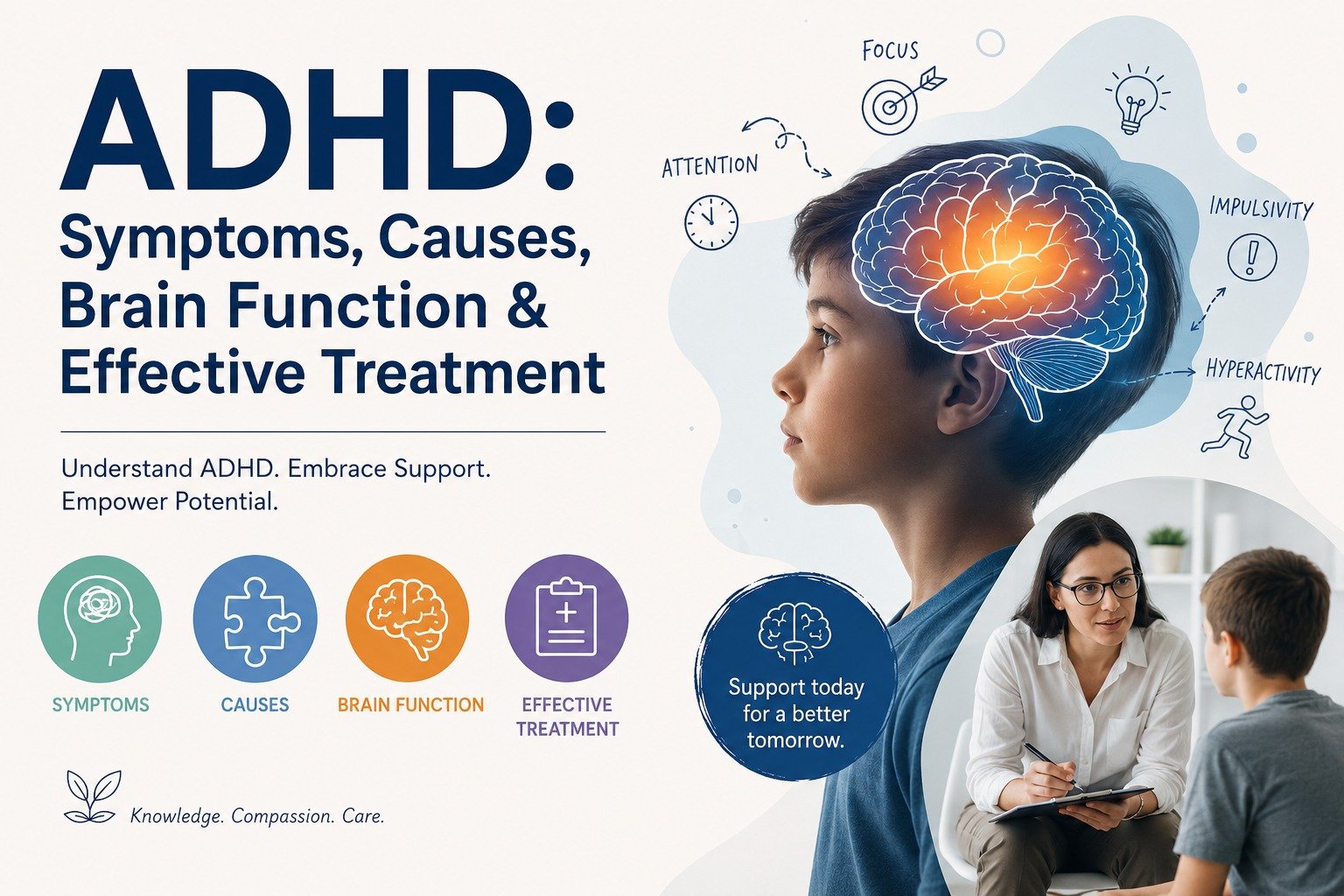
ADHD: Symptoms, Causes, Brain Function & Effective Treatment
Understanding ADHD Beyond Focus and Hyperactivity
May 10, 2026
Khushboo Saini
A lot of people think ADHD is just about "not focusing" or being overactive. You might have even heard someone say, "Bas dhyaan nahin lagata" or "bahut zyada hyper hai."
But if you've actually lived with a child (or even an adult) with Attention-Deficit/Hyperactivity Disorder, you know it's much more than that. It shows up in everyday life—in unfinished work, constant reminders, emotional ups and downs, and sometimes even low confidence.
The important thing to understand is this: ADHD is not carelessness or bad behavior. It's a difference in how the brain works.
What is ADHD?
ADHD is a neurodevelopmental condition. That means the brain develops and functions a little differently—especially in areas related to attention, self-control, and activity levels.
Because of this, a person may find it difficult to:
- Stay focused for long
- Control impulses
- Stay organized in daily tasks
And no, this is not something the child is doing on purpose.
What Happens in the Brain in ADHD?
You don't need to understand deep science, but a basic idea helps.
In ADHD, the part of the brain that helps with focus and decision-making (called the prefrontal cortex) doesn't work as efficiently. Other areas that help control movement and timing also don't coordinate perfectly.
There's also an imbalance in chemicals like dopamine—the one that keeps us motivated and interested. That's why children with ADHD can focus very well on things they enjoy, but struggle with tasks that feel boring or repetitive.
Types of ADHD: Understanding Different Presentations
Not every child with ADHD behaves the same way. Generally, it shows up in three forms:
- Inattentive type: Mostly distracted, forgetful, disorganized
- Hyperactive-impulsive type: Very active, restless, acts without thinking
- Combined type: A mix of both
This is why comparison doesn't help—each child's pattern is different.
ADHD Symptoms in Children and Adults (DSM-5 Based)
According to the Diagnostic and Statistical Manual of Mental Disorders, Fifth Edition, symptoms fall into two main groups:
In Children, you may notice:
- Not finishing homework or tasks
- Getting distracted very easily
- Losing things like books or stationery
- Constant movement or restlessness
- Interrupting others or talking a lot
In Adults, it may look like:
- Poor time management
- Difficulty meeting deadlines
- Disorganization
- Emotional ups and downs
- Struggles in relationships
These symptoms should be present for at least 6 months and affect daily life.
What Causes ADHD?
One thing to be very clear about—ADHD is not caused by bad parenting.
It is mainly linked to:
- Genetics (it often runs in families)
- Brain structure and functioning
- Early developmental factors
Certain environmental factors can increase the chances, but they are not the sole cause.
How ADHD is Diagnosed
There's no single test for ADHD. Diagnosis usually involves a proper assessment by a psychologist or psychiatrist.
They look at:
- Behavior patterns over time
- Feedback from parents and teachers
- Impact on daily life
So if you're unsure, self-diagnosing is not the best idea—professional guidance helps.
ADHD Treatment and Management Strategies
ADHD doesn't have a "quick fix," but it can be managed very well with the right support.
Common approaches include:
- Behavioral therapy
- Cognitive Behavioral Therapy (CBT)
- Medication (in some cases)
- Occupational therapy (especially for children)
Along with this, simple lifestyle changes like routine, physical activity, and reducing distractions make a big difference.
Behavioral Therapy for ADHD: Practical Approaches
This is one of the most practical approaches.
Instead of punishment, it focuses on:
- Rewarding good behavior
- Breaking tasks into small steps
- Creating simple routines
For example, instead of saying "Finish your homework," you say, "Let's do one page first, then take a break."
Small changes like this actually work.
Role of Parents and Teachers in ADHD Management
Support at home and school makes a huge difference.
What helps:
- Clear and simple instructions
- Fixed routines
- Appreciating effort, not just results
- Staying patient (even when it's hard)
Honestly, children with ADHD don't need strict control—they need consistent support.
Effective Activities and Interventions for ADHD
You don't always need therapy sessions—small activities at home also help:
- Puzzles and memory games → improve focus
- Physical activities → release extra energy
- Art and creative work → improve expression
- Breathing exercises → help calm the mind
Keep it simple and consistent—that's what works.
Conclusion: ADHD is Different, Not Deficient
ADHD is not something that needs to be "fixed." It just needs to be understood in the right way.
With the right support, guidance, and patience, children and adults with ADHD can do really well in life.
At the end of the day, what they need most is not constant correction—but understanding, encouragement, and someone who believes in them.
By Khushboo Saini
Contact Info
Chandigarh, India
9817303032
officialmanoshala@gmail.com
© 2026 Manoshalaa. All rights reserved.
Developed by TerraDigitalize Dynamics